
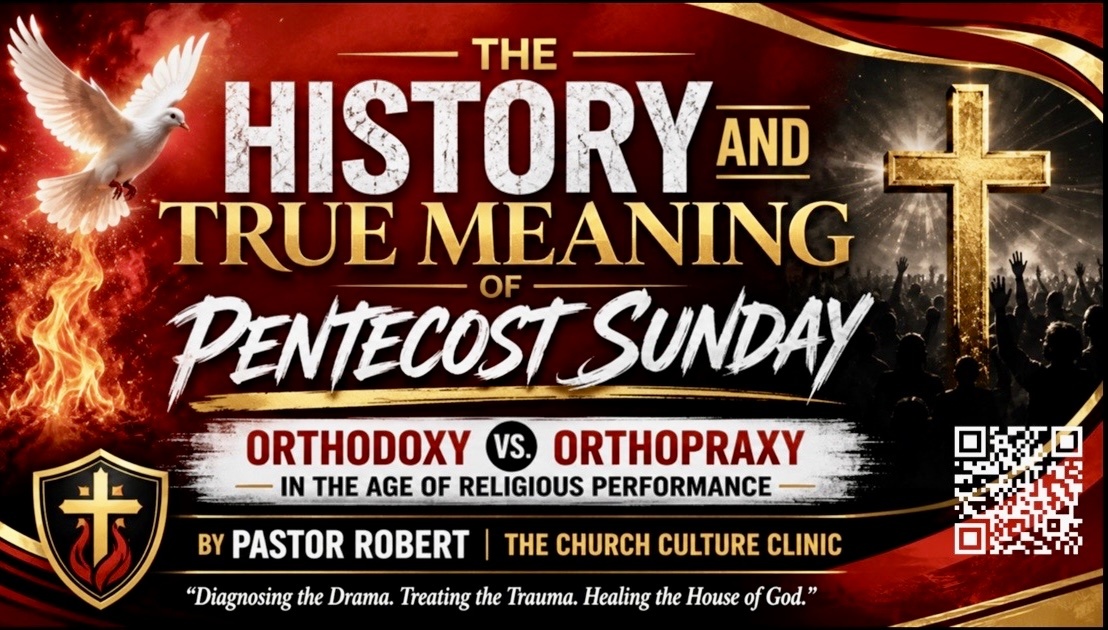
By Pastor Robert | The Church Culture Clinic: “Diagnosing the Drama. Treating the Trauma. Healing the House of God.”
Every year around Pentecost Sunday, churches across America begin preparing for one of the most emotionally charged celebrations on the Christian calendar. Choirs rehearse harder. Flyers become more elaborate. Social media timelines fill up with red flames, white garments, fire emojis, shouting clips, and dramatic organ runs that could wake up the Apostle Paul himself.
And somewhere between the all-white attire, the “old-fashioned Pentecostal service,” and the race to produce the best TikTok promo video, one question quietly lingers in the background:
Are we truly honoring Pentecost—or merely performing Pentecostalism?
As someone born and raised in the classical Pentecostal church, with an earned degree in Biblical & Pastoral Studies and a minor in Psychology, I say this carefully, respectfully, and honestly: much of the modern “celebration” of Pentecost is, in many cases, sincerely misguided and predominantly performative.
That statement recently stirred some conversation after I commented on Facebook that much of today’s Pentecost emphasis often has less to do with the orthodoxy of the Lord’s Church and more to do with creating a moment that will put “butts in the seats”—an old professional wrestling term used to describe drawing a crowd.
And if we’re honest, many churches know exactly what they’re doing.
After all, Pentecost Sunday conveniently lands during a financially challenging season:
- Inflation still hovering around 3.8%
- Gas prices flirting with $5 per gallon
- Graduation ceremonies pulling families in every direction
- Memorial Day weekend marking the unofficial start of summer travel
So churches feel pressure to produce a “big day.”
And suddenly Pentecost becomes less about the power of the Holy Spirit and more about attendance metrics, social engagement, emotional nostalgia, and salvaging a decent offering.
“But church sho’ was good!”
Yes… but was it biblical?
That’s the tension between orthodoxy and orthopraxy.
Orthodoxy refers to right belief. Orthopraxy refers to right practice.
The early church in Acts 2 did not gather to manufacture emotional spectacle. They gathered in obedience to Christ’s command to wait for the promise of the Father. Pentecost was not originally about choreography, color coordination, or curated emotional moments. It was about divine empowerment for kingdom mission.
The word “Pentecost” itself comes from the Greek word Pentēkostē, meaning “fiftieth,” marking fifty days after Passover. In Jewish tradition, it coincided with the Feast of Weeks. But in Christian history, Pentecost became the moment the Holy Spirit descended upon the believers gathered in the Upper Room.
There was wind. There was fire. There were tongues. But there was also conviction, repentance, evangelism, generosity, unity, and transformation.
That’s the part many modern celebrations conveniently skip.
We love the shout.
We love the dance.
We love the aesthetic.
But we often avoid the accountability, holiness, discipleship, and sacrificial living that authentic Pentecostal power produces.
And this is where the comparison to professional wrestling becomes painfully relevant.
In the old territorial days of wrestling—before “sports entertainment” became the preferred branding—the biggest stars succeeded for two primary reasons:
1. Their ability to talk during weekly TV interviews
2. Their gimmick—the character they portrayed
With the right promo and the right gimmick, promoters could put “butts in the seats” at arenas every week.
Sound familiar?
Today, churches compete with:
- The best flyers
- The sharpest livestream graphics
- The most emotional worship clips
- The loudest Hammond organ runs
- The most nostalgic “old-school Pentecostal” atmosphere
Some churches dress in all white. Others in all red to symbolize fire. Some intentionally bring back testimony services and tarrying services for one Sunday only—as if Pentecostal authenticity can be rented for a weekend like party equipment.
And again, I’m not against Pentecostalism. I am Pentecostal.
I believe in the power of the Holy Spirit.
I believe in expressive worship.
I believe in divine encounter.
I believe God still heals, delivers, empowers, and transforms lives.
But we must be authentic and respectful in how we practice Pentecostal faith.
My late pastor, Bishop Derrick W. Hutchins, used to say:
“We’re not foolishly fanatical, nor rigidly formal. But we’re earnestly evangelical, and purely Pentecostal.”
That balance matters.
Because somewhere along the way, parts of the modern church traded authenticity for aesthetics.
Substance for spectacle.
Conviction for content creation.
The Holy Spirit was never given merely to help us have church.
The Holy Spirit was given to help us be the Church.
Real Pentecostal power doesn’t end with a dance.
It changes marriages.
It transforms communities.
It convicts hearts.
It empowers evangelism.
It fuels missions.
It produces fruit—not just moments.
And perhaps that is the greatest challenge facing the modern Pentecostal movement: distinguishing between genuine spiritual fire and carefully engineered emotional atmosphere.
At The Church Culture Clinic, these are the kinds of conversations we believe the Church must courageously have if we are going to remain healthy, relevant, and biblically faithful in the 21st century.
If your church or ministry needs guidance in fulfilling the vision God has given you, we would love to help you strengthen five key areas of ministry:
- Financial management and procurement
- Leadership and ministry development
- Music and fine arts production
- Media and technology advancement
- Community engagement and civic advocacy
Join The Church Culture Clinic on Facebook and message me for a free consultation.
And don’t forget to join me weekly on The Church Culture Clinic Podcast, available wherever you podcast. Powered by The RCTV Network.
My Treatis to Pastors
Pastor, you were created to fulfill your grand design. Let’s go!
Click the link for a free ministry consultation with Pastor Robert.
https://www.facebook.com/share/1ah7LBXToS/?mibextid=wwXIfr
CashApp: $RobCarpenter2
- Venmo: @RobCarpenter2
- Coinbase: @robcarpenterii
- PayPal: @RobCarpenter2
- Zelle: [email protected]
https://cash.app/$RobCarpenter2
Dear friends, family, and kind-hearted supporters,
I’m Robert Carpenter, a dedicated middle school math teacher and assistant pastor, reaching out in a time of unimaginable hardship. Life has thrown me into a perfect storm of challenges: I’ve recently begun treatment for cancer, which has brought both emotional and financial strain, and I’m entangled in a distressing legal battle due to domestic violence. My estranged wife has filed for divorce, seized our vehicle, and manipulated our lease agreement by removing my name, putting me at risk of homelessness. These actions have left me vulnerable, but I’m determined to fight back with your help.
gofund.me/87732567
Since Timmy says that social media is lying on him, Tuesday night at 10 PM EST on TheRCTVNetwork.locals.com (subscription) I will prove why he’s called Arrogant Anthony and why he’s called Lyin’ Timmy. Trust me…These receipts are longer than receipts at a CVS Pharmacy. Let’s go! #COGGA22 #drainthecogswamp #cogequity #rctvnetwork
HOT DOG! IT’S CHURCH TIME!!
Our Church School lesson today was entitled:
“God Is With Those Who Honor Him.”
(And yes, I still go to Sunday School! Some of us never graduated.)
That lesson left me with a simple but profound question that I want to share with you on this beautiful Sunday:
“Am I honoring God with my life?”
Not merely with what I say on Sunday morning. Not just with my church attendance, title, position, or public profession of faith.
But with my choices. Relationships. Character. Finances. Words. Work. Private decisions. Treatment of others. And what I do when nobody is watching.
Sometimes the most important Sunday lesson isn’t the one we apply to everybody else. It’s the one that makes us examine ourselves.
So today, I’m doing some self-examination: Am I honoring God in my life? How would you answer that question today?
Now, worship the Lord, enjoy this beautiful day, and make it count.
The future looks bright. Let’s go!
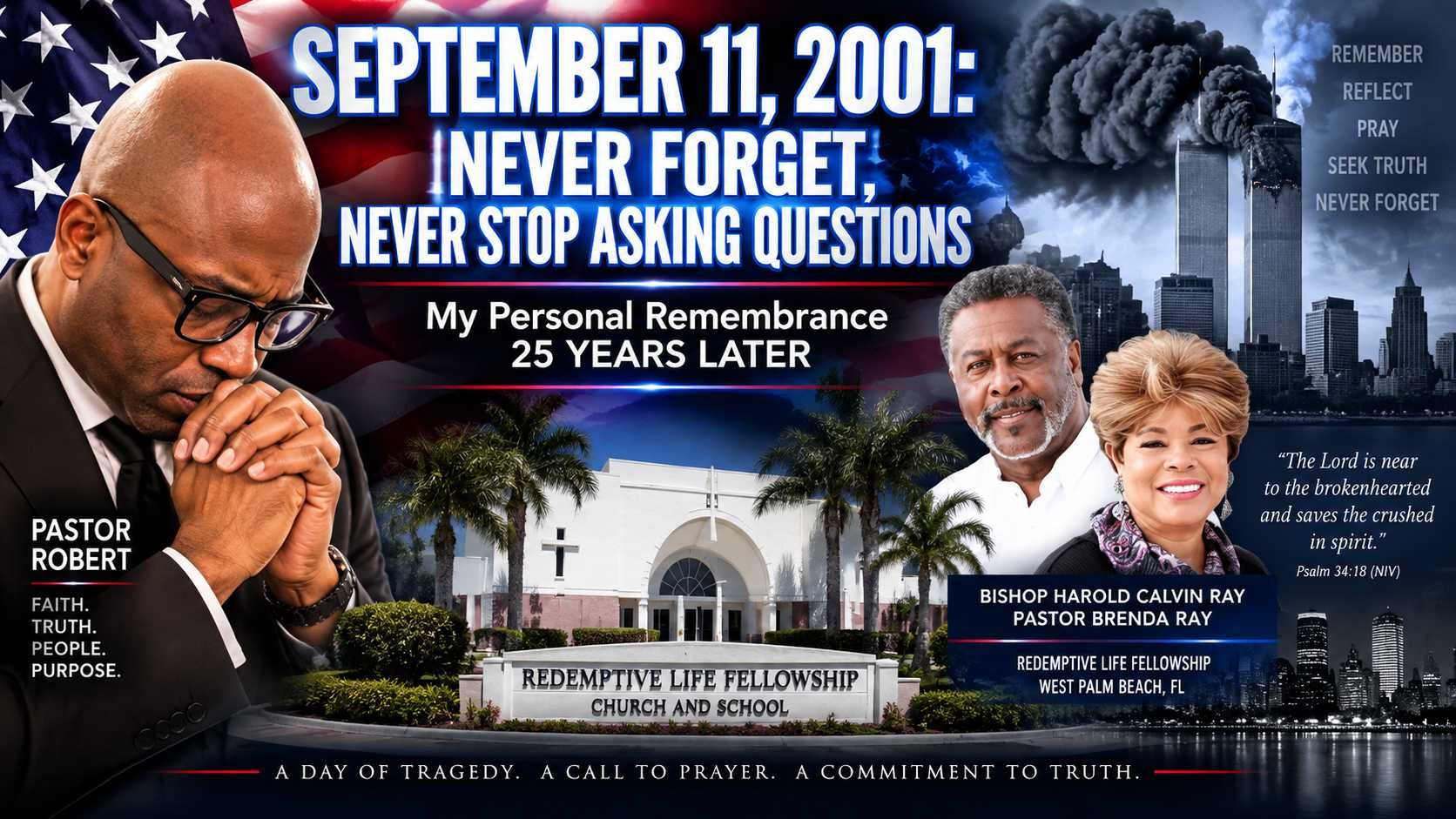
On the morning of September 11, 2001, I was serving as the Administrative Pastor at Redemptive Life Fellowship in West Palm Beach, Florida, under the leadership of the late Bishop Harold Calvin Ray and Pastor Brenda Ray. Because of the demanding schedule and having not yet relocated my residence to West Palm Beach, I was staying at a local Marriott near the church campus.
I was getting dressed for the day when the television broadcast broke in with images of the first tower burning. Moments later, I watched the second plane strike the South Tower. The realization set in instantly: our nation was experiencing a catastrophic breach. Instead of finishing my morning routine, I sat frozen on the edge of the bed, fixed to the screen in prayer, wondering where the next blow would land. Over the next hour, disbelief turned to shock as the South Tower collapsed, followed shortly after by the North Tower, descending rapidly in clouds of dust. News reports rapidly escalated—a strike at the Pentagon, and soon after, ...