
There is a growing tension in America that can’t be ignored, and it didn’t start yesterday. It has been building for decades—layer by layer, moment by moment—until now we find ourselves asking a question that would have seemed unthinkable in earlier generations: What is actually true anymore?
To understand how we got here, you have to go back to the 1960s. That era didn’t just reshape culture—it fractured trust. The assassinations of President John F. Kennedy, Senator Robert Kennedy, Rev. Dr. Martin Luther King Jr., and Malcolm X were not just tragic losses of influential leaders; they were seismic events that shook the confidence of the American people in their institutions. Questions lingered. Investigations concluded, but doubts remained. And where doubt lives long enough, distrust begins to take root.
From that point forward, trust in government—on both sides of the political spectrum—began a slow but steady decline. Add to that the evolving role of the mainstream media. Once viewed as the gatekeepers of truth, legacy outlets have, in the eyes of many, lost credibility due to perceived bias, selective reporting, and the blurring of lines between journalism and commentary. Whether that perception is fully justified or not, the result is the same: skepticism has become the default setting.
Then came social media.
Now, information doesn’t trickle down—it floods. Everyone is a publisher. Everyone has a platform. And while that democratization of information has its benefits, it also means misinformation, speculation, and outright fabrication can spread just as quickly—sometimes faster—than verified facts. And now, layered on top of that, is artificial intelligence, capable of generating content so realistic that distinguishing between authentic and artificial is becoming increasingly difficult.
So here we are. In a moment where people are not just questioning what happened, but whether what they’re seeing is real at all.
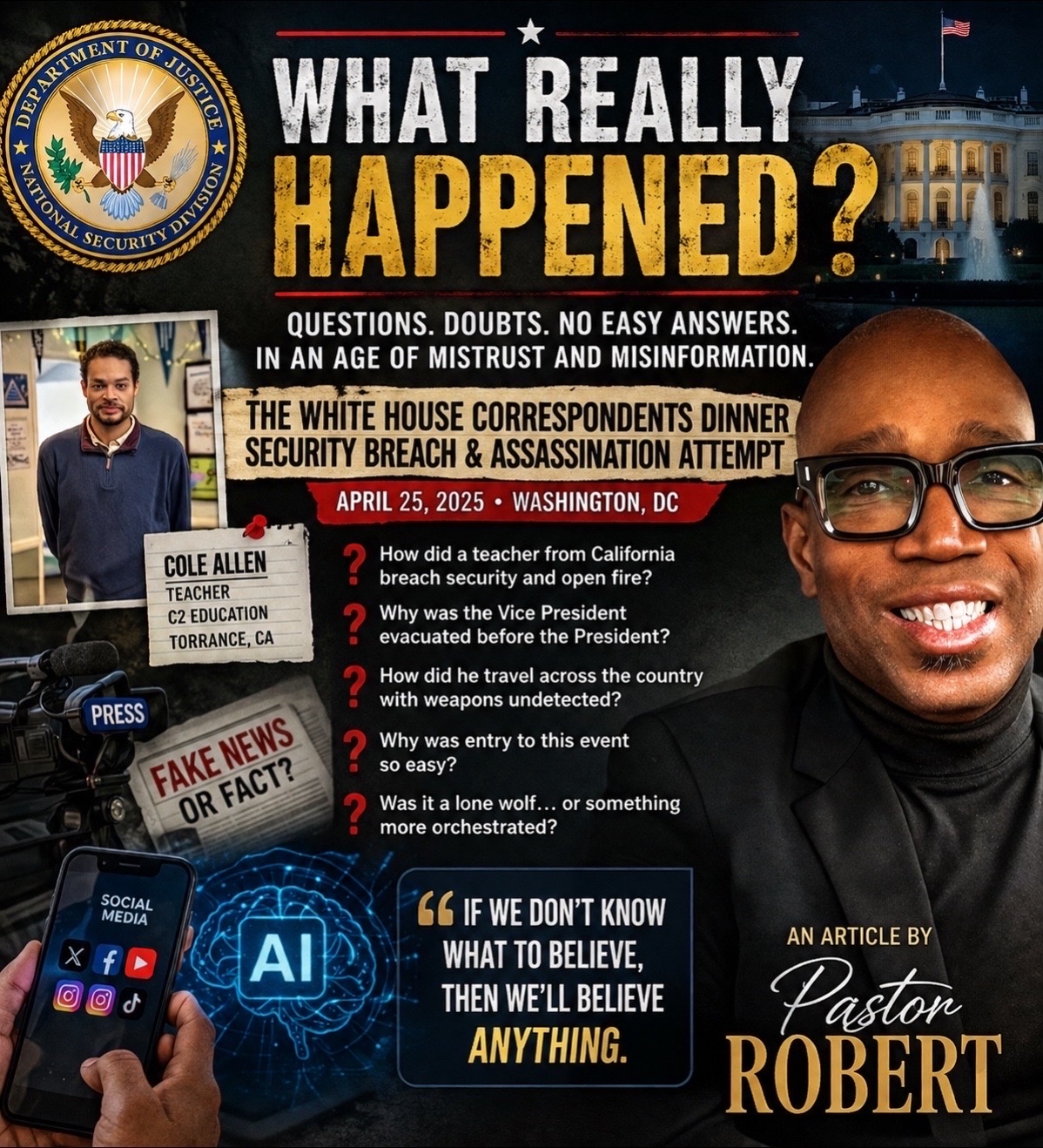
The reported security breach and attempted assassination at the White House Correspondents Dinner on April 25 has only intensified this crisis of confidence. This wasn’t a small, obscure gathering. This was a high-profile event attended by approximately 2,500 individuals, including members of the press, top government officials, the President, Vice President, cabinet members, and their families. An event of that magnitude should, by all expectations, have been secured at the highest possible level.
And yet, the questions come rapidly—and they are not trivial.
How does an individual reportedly travel across the country with weapons without detection? How does someone gain access to a hotel hosting such a sensitive event without thorough screening? Why were there accounts suggesting minimal checks at entry points prior to the main ballroom security? Why were certain officials evacuated before others? Why do some eyewitness accounts seem to contradict what people would expect from standard Secret Service protocols?
Now, to be clear, questions are not the same as conclusions. Asking “how” does not automatically imply wrongdoing or conspiracy. But when enough questions stack up without clear, transparent answers, people begin filling in the gaps themselves—and not always responsibly.
That’s the real danger.
Because in an environment where trust is low and information is fragmented, the human mind looks for coherence—even if it has to create it. And that’s how speculation can quickly evolve into belief.
The irony is, two things can be true at the same time: security professionals can act swiftly and effectively in a crisis, and yet earlier layers of security might still appear insufficient or inconsistent. Complexity doesn’t always fit neatly into headlines or viral posts.
But perception matters. And right now, the perception for many Americans is this: something doesn’t add up.
And when people feel like they don’t know what to believe, they don’t just become cautious—they become vulnerable to believing anything.
There’s an old wisdom that fits this moment perfectly: “For God is not the author of confusion, but of peace…” (1 Corinthians 14:33). Yet confusion is exactly what defines this era—politically, socially, and informationally.
So where does that leave us?
It leaves us with responsibility. Not just to question—but to question wisely. Not just to seek answers—but to demand clarity without rushing to conclusions. It calls for discernment in a time when discernment is in short supply.
Because if truth becomes optional, then reality becomes negotiable. And when reality becomes negotiable, trust doesn’t just decline—it disappears.
And once trust is gone… rebuilding it is a whole different mission.
So the question remains—and it’s not just about one event in Washington:
What do you believe… and more importantly, why?
Comment as you see fit!
My Treatis to Pastors
Pastor, you were created to fulfill your grand design. Let’s go!
Click the link for a free ministry consultation with Pastor Robert.
https://www.facebook.com/share/1ah7LBXToS/?mibextid=wwXIfr
CashApp: $RobCarpenter2
- Venmo: @RobCarpenter2
- Coinbase: @robcarpenterii
- PayPal: @RobCarpenter2
- Zelle: [email protected]
https://cash.app/$RobCarpenter2
Dear friends, family, and kind-hearted supporters,
I’m Robert Carpenter, a dedicated middle school math teacher and assistant pastor, reaching out in a time of unimaginable hardship. Life has thrown me into a perfect storm of challenges: I’ve recently begun treatment for cancer, which has brought both emotional and financial strain, and I’m entangled in a distressing legal battle due to domestic violence. My estranged wife has filed for divorce, seized our vehicle, and manipulated our lease agreement by removing my name, putting me at risk of homelessness. These actions have left me vulnerable, but I’m determined to fight back with your help.
gofund.me/87732567
Since Timmy says that social media is lying on him, Tuesday night at 10 PM EST on TheRCTVNetwork.locals.com (subscription) I will prove why he’s called Arrogant Anthony and why he’s called Lyin’ Timmy. Trust me…These receipts are longer than receipts at a CVS Pharmacy. Let’s go! #COGGA22 #drainthecogswamp #cogequity #rctvnetwork
HOT DOG! IT’S CHURCH TIME!!
Our Church School lesson today was entitled:
“God Is With Those Who Honor Him.”
(And yes, I still go to Sunday School! Some of us never graduated.)
That lesson left me with a simple but profound question that I want to share with you on this beautiful Sunday:
“Am I honoring God with my life?”
Not merely with what I say on Sunday morning. Not just with my church attendance, title, position, or public profession of faith.
But with my choices. Relationships. Character. Finances. Words. Work. Private decisions. Treatment of others. And what I do when nobody is watching.
Sometimes the most important Sunday lesson isn’t the one we apply to everybody else. It’s the one that makes us examine ourselves.
So today, I’m doing some self-examination: Am I honoring God in my life? How would you answer that question today?
Now, worship the Lord, enjoy this beautiful day, and make it count.
The future looks bright. Let’s go!
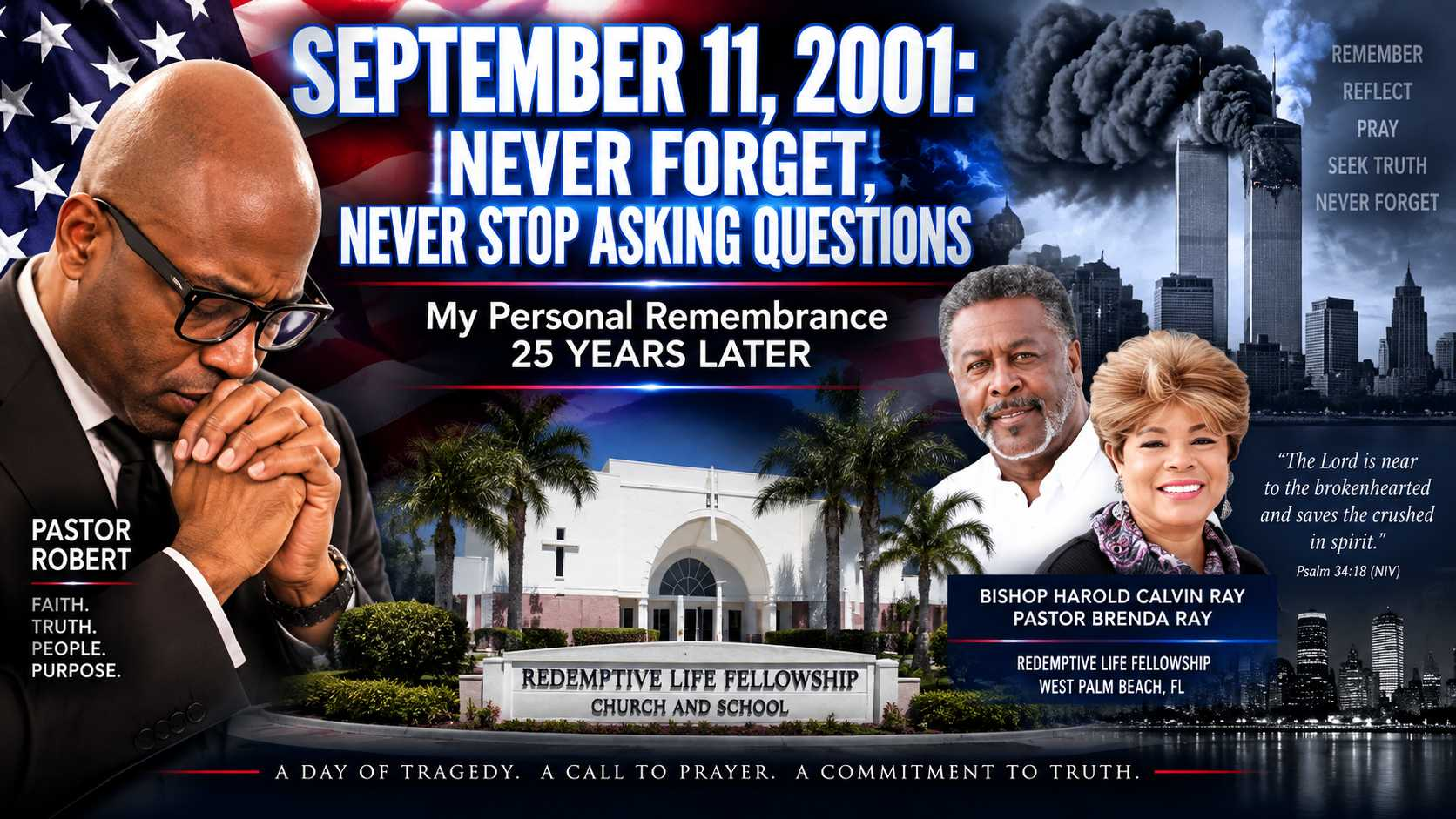
On the morning of September 11, 2001, I was serving as the Administrative Pastor at Redemptive Life Fellowship in West Palm Beach, Florida, under the leadership of the late Bishop Harold Calvin Ray and Pastor Brenda Ray. Because of the demanding schedule and having not yet relocated my residence to West Palm Beach, I was staying at a local Marriott near the church campus.
I was getting dressed for the day when the television broadcast broke in with images of the first tower burning. Moments later, I watched the second plane strike the South Tower. The realization set in instantly: our nation was experiencing a catastrophic breach. Instead of finishing my morning routine, I sat frozen on the edge of the bed, fixed to the screen in prayer, wondering where the next blow would land. Over the next hour, disbelief turned to shock as the South Tower collapsed, followed shortly after by the North Tower, descending rapidly in clouds of dust. News reports rapidly escalated—a strike at the Pentagon, and soon after, ...